
2026年6月号掲載
- to satisfy patient needs -
【PR】 Round-table Talk Identifying the current position of denture adhesives
※This article is based on content from 「The Quintessence: June 2026 Issue」 and has been published here.
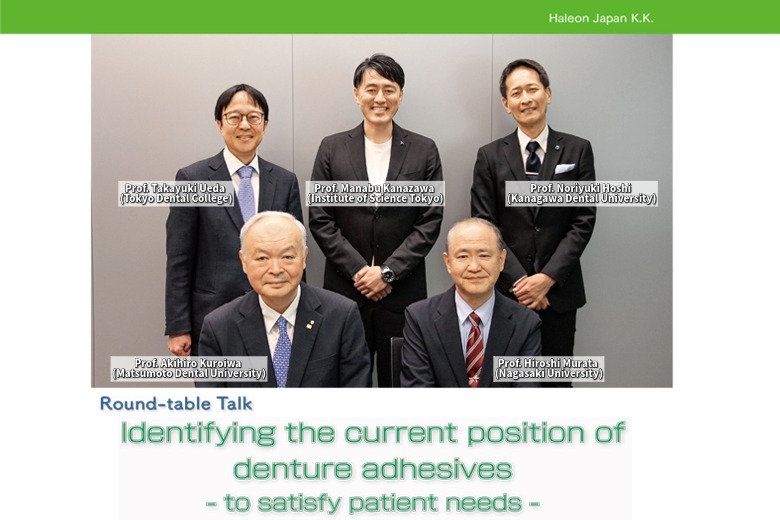
In our modern, super-aging society, where it is not uncommon for us to attain an age of 100 years, the proportion of patients using dentures is also increasing year by year. While there is a great patient need for denture adhesives, we wonder whether we can currently provide proper information from the standpoint of dental professionals. Accordingly, we have invited some specialists in the field to discuss the measures required for patients to use denture adhesives appropriately.
Introduction
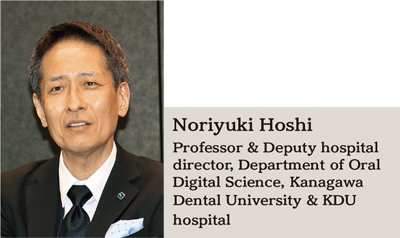
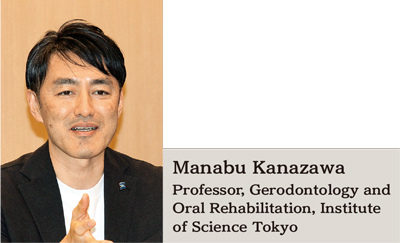
Akihiro Kuroiwa: In our modern, super-aging society, we can see increasing patient requirements for denture adhesives. I would value a discussion on what we can do to inform patients of appropriate use of denture adhesives and how we might influence the perspective of dental professionals. Today, we have invited several highly respected doctors: Dr. Hiroshi Murata, Dr. Takayuki Ueda, Dr. Noriyuki Hoshi, and Dr. Manabu Kanazawa to participate in a round-table talk discussing the “usefulness and potential of denture adhesives.”
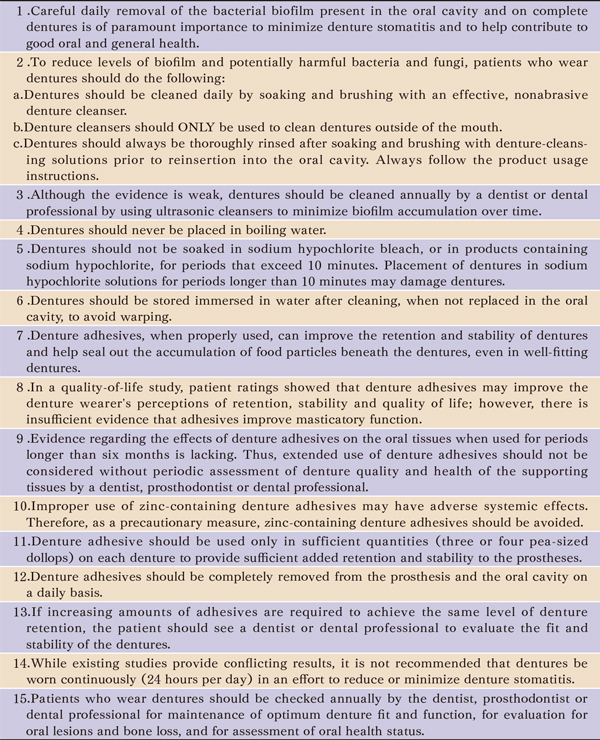
Hiroshi Murata: I believe that some dentists still have a negative opinion of denture adhesives. However, the International Organization for Standardization (ISO) established an international standard for denture adhesives, and the American Dental Association(ADA) published Guidelines (Table 1)1 ,2 in 2011, which suggest that patients find denture adhesives useful if they are used properly. We dental professionals should be aware of the fact.
We need an environment in which we can talk openly about denture adhesives
Kuroiwa: It is important that patients use denture adhesives appropriately so that they can improve their quality of life (QOL) and lead comfortable lives. I feel that, as academics, we should have debates with manufacturers about denture adhesives in a social context. It is important that anyone currently in clinical practice who reads this should obtain accurate information about use of denture adhesives, and deliver their benefits to patients.
Takayuki Ueda: I suppose that patients have no idea about what we dentists think of denture adhesives. They therefore cannot decide whether they should use them or not. On top of this, patients do not want their dentists to think they are not satisfied with the dentures they have prepared. Therefore, I believe it is also our responsibility to create an environment in which patients can talk openly about denture adhesives.
Kuroiwa: It is true that there are a considerable number of patients who secretly use these adhesives.
Noriyuki Hoshi: I am sure that ordinary patients are reluctant to use denture adhesives, as sold at drugstores, because they are afraid that wearing their dentures with these adhesives may imply distrust of their dentists. In contrast, patients may actually have situations where they want to use denture adhesives. I feel that we currently have no medical system in place to address the concerns of these patients.
In the setting of care delivered at home visits, patients’ family members and caregivers are involved. They too won’t know how to use denture adhesives. This is simply because they have not been properly instructed by dental professionals. I believe that we have not provided enough information, including information about oral hygiene and denture management.
Handling dentures may be one of the problems that patients, their family members and caregivers experience.
Kuroiwa: I am sure that as dental professionals we are not providing enough information. We therefore need to have accurate information concerning denture adhesives.
Denture adhesives provide patients with comfort in key situations
Kuroiwa: What are the positive impacts on patients when they use denture adhesives?
Manabu Kanazawa: Denture adhesives provide advantages that potentially address patients' concerns about the use of dentures, such as pain, penetration of food particles, and poor retention. Basically, denture adhesives should be used in conjunction with well-fitting dentures. Use of dentures that fit mucosal surfaces poorly and occlude poorly, if left untreated, may result in further deterioration of the oral environment. I anticipate that patients will use denture adhesives primarily for well-fitting dentures under the supervision of dentists.
One of the advantages of denture adhesives for patients is that they provide patients with peace of mind when used at important moments during activities or events such as presentations, dinners, and traveling. I have observed denture adhesives improving patients' QOL in situations where patients get together to talk, sing, and laugh.
Kuroiwa: Indeed, if patients can be supported psychologically by denture adhesives in attempts to avoid failures, including detachment of the dentures during important situations such as making a speech in front of people, denture adhesives can play a very positive role.
It is essential to educate dental professionals about denture adhesives
Kuroiwa: Dental professionals are also unsure whether or not they can really recommend denture adhesives to their patients.
Murata: I think that this issue arises from university education. It is likely most important that we provide proper education about denture adhesives at universities and dental hygienist schools. Denture adhesives used to evoke a notion that they are used as a consequence of the poor skills of dentists. Now, on the contrary, they are widely recognized and have obtained ISO standards based on accumulated evidence of improved patients’ QOL and satisfaction. Accordingly, I believe denture adhesives will become more and more important in the future.
Kuroiwa: We dental professionals need to learn appropriate information about denture adhesives and provide this information to patients. With that in mind, how do we get the concept to permeate into university and school education, and furthermore, how should we spread it to the government and related medical and nursing settings?
Kanazawa: I believe that it is necessary for academic societies, universities, government, and manufacturers to work together toward a common goal. All of us must share the same feelings and knowledge and then spread this through conferences and round-table talks like this one. To that end, education is important and needs to be changed. We need to approach the uneducated generations anew.
To meet this need, I believe that it will be easier to spread the idea if educators make efforts to create educational kits/slide sets that can be used easily; they also need to be prepared to introduce them into classes.
Kuroiwa: We must make efforts to improve several different aspects. I hope that young and mid-career dentists will read this round-table talk and become motivated to learn because we are living this era.
Murata: While many patients who visit university hospitals are healthy, few of those encountered in clinical settings, including care delivered at home visits, are healthy. The residual ridges will also have been absorbed considerably. When young dentists enter clinical practice in circumstances where the number of people in a poor condition is increasing, they will often find it difficult to treat patients as described in textbooks. In such situations, they may feel that denture adhesives are necessary.
When I wrote a feature article on denture adhesives for this journal, a practitioner who was a reader of the article commented that an organized explanation by a university professor specializing in prosthodontics had allowed him/her to understand better when to consider using denture adhesives. I believe that it is important for us as academics to actively engage in educational activities in this way.
Cases of appropriate use of denture adhesives and the timing of introduction
Kuroiwa: Please mention the types of patient for whom denture adhesives are appropriate.
Ueda: As well as common cases where the denture fits well but comes off easily, I think the four cases shown in Table 2 are most suitable.
I also believe that denture adhesives will work even during the adaptation stage, right after the patient has received new dentures. In this super-aging society, it may take a long time for patients with oral frailty to adapt to new dentures because of the difference in shape from that of the old ones that were replaced. You may have used the expression "You will get used to it in a little while."
The rate at which people age now differs from that in the past, and many patients are frail. In such circumstances, I feel that it would be good to introduce denture adhesives first during denture manufacture, and have patients try them. We should encourage patients to use denture adhesives to get used to them. Patients who are used to dentures and no longer need denture adhesives do not need to use them. When patients are more comfortable with denture adhesives, we should encourage them to use these adhesives under the guidance of dentists. I feel that they are useful as a tool that keeps dentures in place.

Kuroiwa: What about the timing of introduction of denture adhesives?
Hoshi: I feel that it is a good thing to provide a denture adhesive from the very start or at least to provide information on denture adhesives, especially if patients’ QOL is improved with their use.
We will have more patients with dementia in the future; therefore, it is important for us to prepare fully before the onset of the disease. I hope that patients will obtain information on denture adhesives and master how to use them while they are still young and can visit hospitals. When circumstances change in the future, the understanding of patients and those around them about denture adhesives will lead to them maintain and improve their quality of life.
Kuroiwa: It is important to provide patients with information and education taking account of their future course.
Classification and characteristics of denture adhesives
Kuroiwa: Next, we will look at the classification and features of denture adhesives.
Murata: Denture adhesives are classified into denture adhesives and home reliners( cushion-type)( Figure 1 )3 . Home reliners are made from vinyl acetate resin and fill the gap between the mucosal surface of the denture base and the mucosal surface under the base. According to the opinion of the Japan Prosthodontic Society 4 , the use of home reliners greatly affects the occlusion and thus is not recommended.
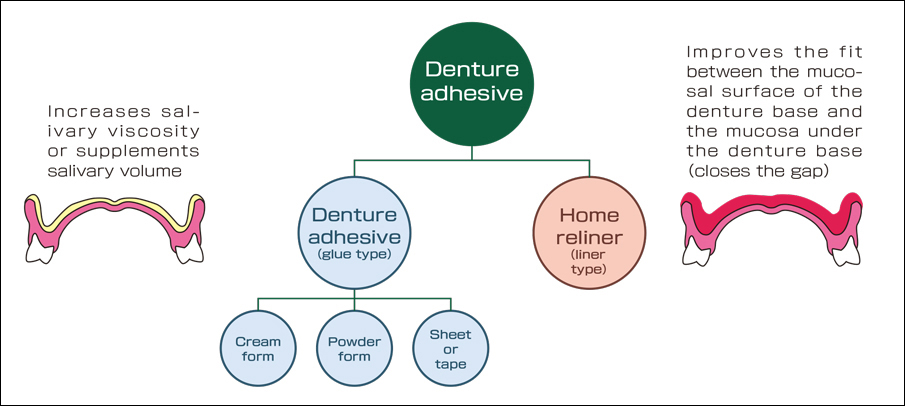
On the other hand, denture adhesives become viscous when combined with saliva. The types of adhesive include cream and powder. The ingredients of both types are water-soluble polymers, and their viscosity increases by absorbing water to enhance adhesiveness. Among dental materials, we have nothing that increases adhesiveness, so from the perspective of material science, we believe that recommending cream-type and powder-type adhesives to patients will cause no problems. Since these adhesives have low viscosity and spread evenly and thinly on the denture base, they are known to have no impact on occlusion or the residual ridges. However, if we use them incorrectly, they will become sticky and cause discomfort and hygiene-related problems. Therefore, it is important to provide patients with training. Since the physical properties of powder-type denture adhesives vary depending on the amount of moisture absorbed, I feel that cream-type denture adhesives are better from the viewpoint of ease of use.
Clinical value of denture adhesives for removable partial dentures
Kuroiwa: In terms of the types of denture, the proportion of patients using removable partial dentures is currently increasing. We tend to think that denture adhesives should be used for complete dentures, and there have been many study reports on their use in this area. On the other hand, only a limited number of reports are available concerning the effects of their use for removable partial dentures.
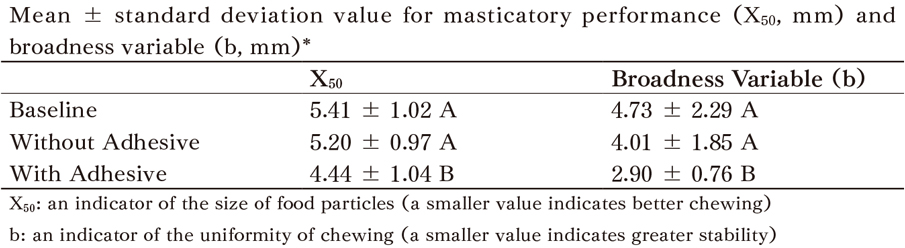
In this respect, a report from Brazil is significant. This involved clinical research studying the efficacy of denture adhesives for removable partial dentures. I would like to introduce it here (Table 3 ). This randomized, crossover clinical trial concluded that the daily use of denture adhesives is useful for patients with distal extension removable partial dentures. Particularly, improvement of masticatory function, decrease in rotational shaking of dentures, significantly improved patient satisfaction, and improved QOL were confirmed; denture adhesives were reported to have high clinical value as a convenient and non-invasive form of supportive care 5 .
We now have evidence that denture adhesives are effective for removable partial dentures. Actually, patients who use removable partial dentures are relatively young and are assumed to frequently encounter situations where failure must be avoided at any cost in their social lives. Also, distal extension removal partial dentures are prone to generate rotational movement. Therefore, even a slight improvement in stability is expected to greatly affect the psychological status of patients.
Practice of the use of denture adhesives for removable partial dentures
Kuroiwa: Now, we would like to go through the use of denture adhesives for removable partial dentures.
Please take a look at Figure 2. Unilateral distal extension removable partial dentures have a certain resistance to subsidence due to the occlusal force. However, when a force is loaded in the direction toward detachment, the dentures will rise without sufficient fixation if the clasps are not properly designed.
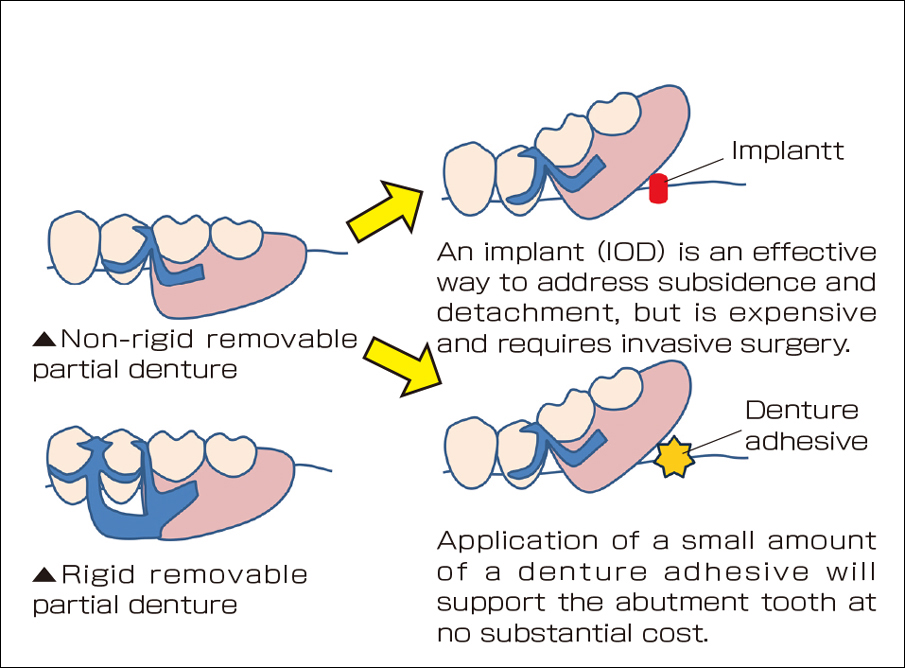
There are a variety of clasp designs, and combined use with an implant is sometimes considered if we try to take care of both subsidence and detachment. However, implants involve challenges such as high cost and invasive surgery. In that context, by applying a small amount of a denture adhesive, the abutment teeth can be supported without substantial costs(Figure 3).
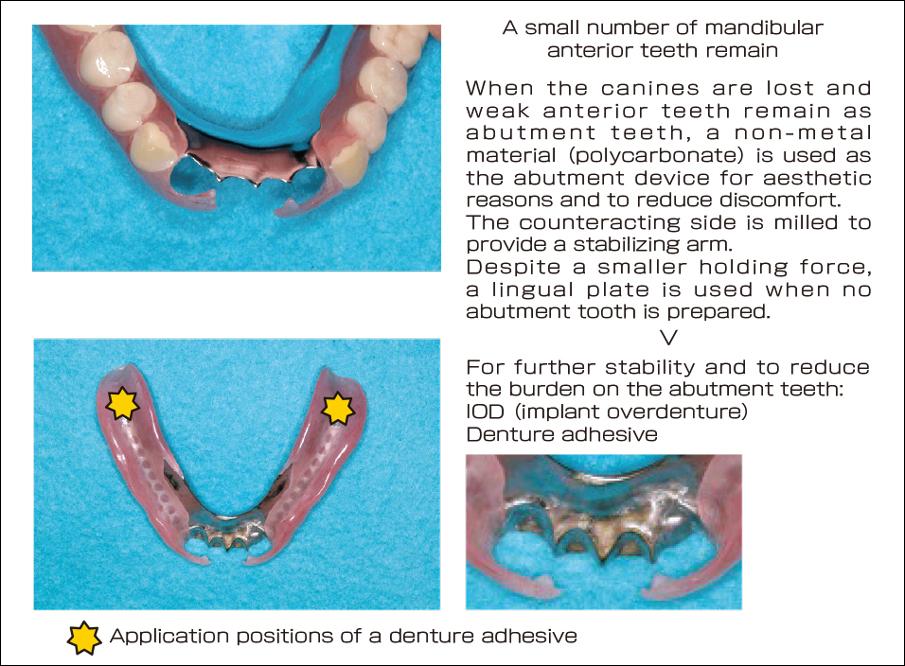
Regarding the position where a denture adhesive is applied, I feel that the concept of a fulcrum line is useful. The fulcrum line is defined in terms of the idea that a denture will be stable if, for example, there are four supporting teeth and the line is equally wide(Figure 4). In someone with just one remaining tooth, a denture will be stabilized with a denture adhesive applied in an appropriate position. This is a clinical summary rather than evidence. The fulcrum line is a concept widely shared in the clinical setting as information for making decisions about denture design. Therefore, if we provide an explanation about the application positions of a denture adhesive using this framework, it will be easier to organize the explanation in relation to the design intent. I would really like both young and experienced dentists to use this idea as a reference when they consider where a denture adhesive should be applied.
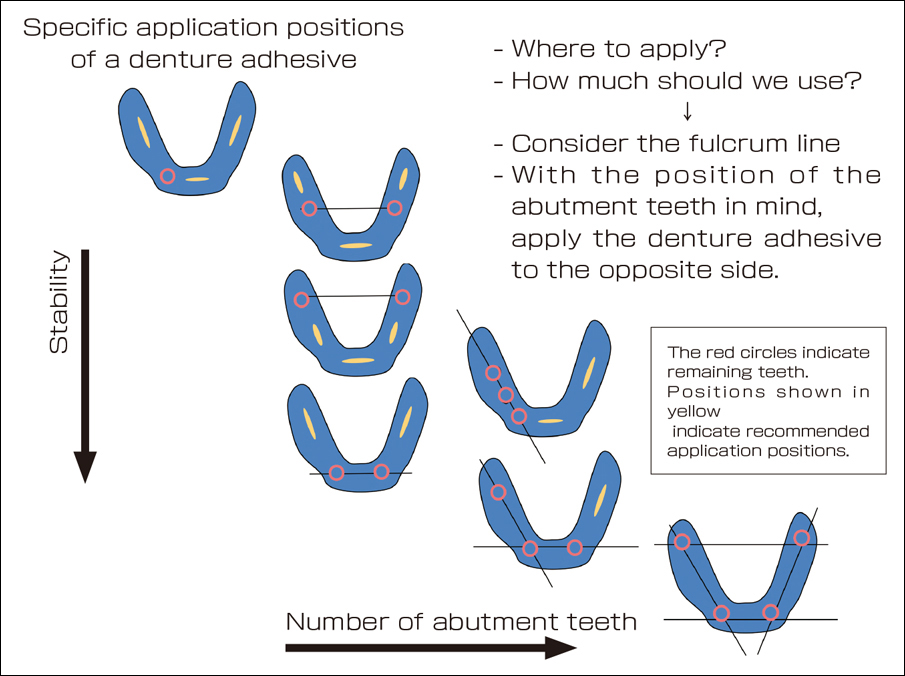
Ueda: I agree with you. While the expression "applying a small amount to a pinpoint site" is sometimes used, it does not clearly indicate specific sites and the amount of denture adhesive to be applied. Therefore, I think that it is useful to show the specific positions to be used based on the concept of the fulcrum line, when providing guidance and explanations.
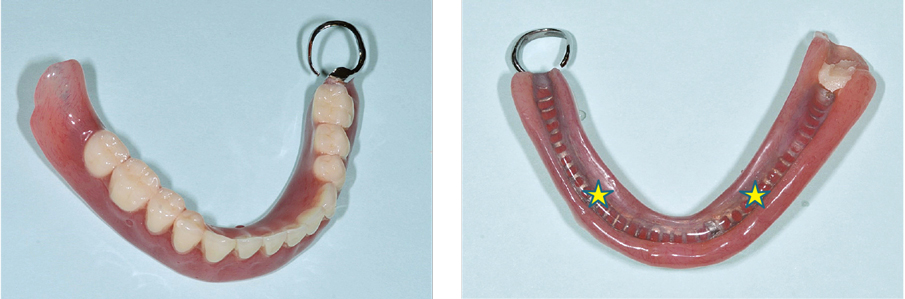
Figure 2 shows a non-rigid, removable partial denture on the top and a rigid one on the bottom. In this era where dentists who do not extract teeth are considered good, no matter how rigid a denture is made, there is still a possibility that the abutment teeth may shake. I believe that applying a denture adhesive in consideration of the fulcrum line is especially
effective in the case of large removable partial dentures with just a few teeth remaining on one side (Figure 5).
Kanazawa: From the viewpoint of immovable dentures, it would be nice if they could be treated with IODs, but IODs are not available to all patients. Denture adhesives could be an alternative solution for patients without the option of implants.
Kuroiwa: We found that denture adhesives are also applicable to removable partial dentures and are effective here. As dental professionals, it is important for us to recognize this and properly communicate with patients.
True experts can propose different options
Kuroiwa: Considering patients’ needs, it is necessary for us as dental professionals to provide patients with appropriate information about denture adhesives.
Ueda: It is still somewhat true that some dentists do not want to use denture adhesives because they think using them is far from the best strategy. However, I believe that true experts can not only provide something technically special but also treat patients using many options. Denture adhesives are one of these options, and we need to have them used by patients.
Hoshi: It is important for us to be prepared to provide information on denture adhesives when patients begin using dentures. If denture adhesives can help patients lead more comfortable and fulfilling lives, we should actively encourage their use. Many patients will spend decades in retirement, therefore, I believe it is essential to consider things from a long-term perspective.
As I mentioned earlier, when patients experience physical weakness and need some help from people around them, both they and their caregivers can enjoy a better quality of life if information on how to use denture adhesives comfortably is shared in advance.
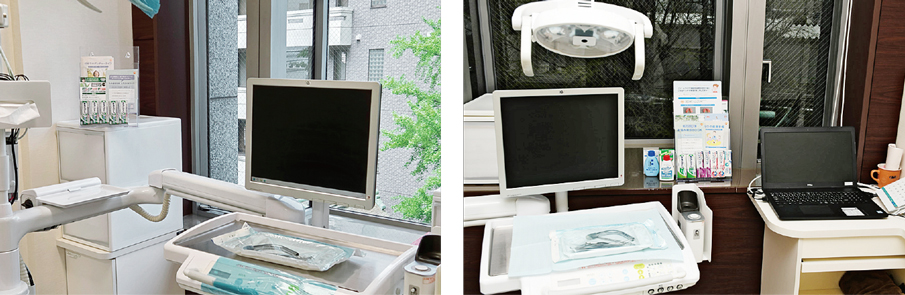
Ueda: In my opinion, one effective approach is to place promotional samples, brochures, and posters in conspicuous places such as waiting rooms in order to actively provide information on denture adhesives at university hospitals and dental clinics. In this way, we can let patients know that denture adhesives are available at the clinic; this also encourages them to talk about denture adhesives without hesitation at the hospital. We are taking these measures at our hospital too(Figure 6).
Maintenance after the use of denture adhesives
Kuroiwa: How should maintenance be carried out after the use of a denture adhesive in actual clinical settings?
Ueda: After using dentures, patients can clean the adhesive off the dentures using a denture brush and detergent. Conversely, the problem is what to do with any adhesive remaining on the mucosa. I believe that the only thing we can do is to provide guidance.
Kanazawa: Just telling patients that denture adhesives will remain on the mucosa will make a big difference.
Murata: Patients are sometimes unaware of a denture adhesive remaining on the mucosa. Both patients and their caregivers tend to focus on cleaning teeth.
Hoshi: Some patients of an advanced age have difficulty using dentures because of an extremely dry mouth. Because saliva is necessary for the use of dentures, I have encountered circumstances where an effective measure in clinical practice involved stabilizing dentures by moistening the oral cavity with an oral moisturizing agent.
Kanazawa: That will greatly help patients resolve the issue of being unable to remove stabilizers by themselves.
Kuroiwa: That's right. However, something may be wrong with how the dentures fit if stability cannot be obtained without a large amount of stabilizer.
Kanazawa: One of the disadvantages of denture adhesives is potential masking of ill-fitting dentures. I want readers to be fully aware of this possibility. Patients can wear ill-fitting dentures if denture adhesives are used. Therefore, in some cases, we fail to
notice the poor fit if patients do not complain about it. I think that it is important for dentists to perform a denture chew test at the time of maintenance, to check for this situation.
A fundamental principle is that denture adhesives should be used for well-fitting dentures. Many people probably think that they should only use a denture adhesive for an ill-fitting denture, but this is not true. I think we need to provide proper education about this misconception.
Simultaneous training about oral care and how to use denture adhesives is important in the setting of nursing care
Kuroiwa: How about the use of denture adhesives in nursing settings?
Hoshi: Patients who are healthy enough to visit a hospital regularly, such as those treated by young dentists when they were clinical trainees, have no significant oral problems. On the other hand, patients who are unable to move and are hospitalized or stay at home due to long-term care needs often have a poor oral environment. When used in such patients, denture adhesives will remain on the abutment teeth in the case of removable partial dentures if the oral cavity and the dentures are not cleaned appropriately. These residual or built-up adhesives, along with poor cleaning, can lead to an environment where bacterial and
fungal growth are likely to occur. When an adhesive has accumulated, it may be difficult for some patients to clean their dentures solely with a simple cleaning sponge, used at home.
As a countermeasure, it is important to share among people involved information not only on the use of a denture adhesive but also on whether or not the denture adhesive left on the dentures and in the oral cavity have been appropriately removed at night by specifying these in the home care plan in advance. Moreover, it is essential for dentists to provide regular
intervention and professionally check the condition of the oral cavity and the dentures.
With regard to denture cleaning, it is important to perform mechanical cleaning to remove food particles and other debris with a dedicated brush as well as chemical cleaning with a denture cleaning agent.
Kuroiwa: People involved in nursing care encounter challenging situations, and I feel that every effort must be made to minimize patients’ risks.
Perspectives of digital dentures and denture adhesives
Kuroiwa: Recently, the turnover rate among dental technicians has been high. In such circumstances, we need to proactively use CAD/CAM. Digital technology is progressing rapidly in dentistry. What perspectives do you have here, in relation to the field of dentures?
Kanazawa: As you know, complete dentures are now covered by health insurance under the name of " 3D-printed removable dentures." Regarding removable partial dentures, I anticipate that assembly-type dentures, in which the metal frame, denture base and artificial teeth are bonded after they are manufactured by 3D printing, may be covered by insurance in the future. However, because they are fabricated like blocks, it is possible that accumulated errors may make it difficult to achieve as good a fit as before. If the fit is acceptable in such cases, I feel that denture adhesives may be able to close the gap. We can envision a future where patients use 3D-printed, removable partial dentures with denture adhesives under the supervision of dentists.
Kuroiwa: We have high expectations regarding the availability of 3D-printed partial dentures in the future. Which is better for complete dentures, 3D printing or milling?
Kanazawa: Comparing milling and 3D printing, I feel that fitting accuracy is better with milling because no shrinkage occurs. Complete dentures manufactured by 3D printing have misalignment because of shrinkage. This results from the process of polymerization of the layers. However, since the conventional PMMA heat-curing resin also shrinks during the polymerization
process, I personally feel that the fitting accuracy is not much different from that of conventional types.
Conventional dentures go through a process consisting of molding, occlusion acquisition, trial fitting, and mounting. On the other hand, we may be able to make the second 3D-printed removable denture immediately, without molding, provided we have the data. For example, if a patient needs new dentures in a year, we may be able to provide the patient with printed dentures right away. In such cases, I feel that it is a good idea for patients to use a denture adhesive for fine adjustment or until they get used to it. I think that 3D-printed dentures and denture adhesives will be compatible solutions.
Kuroiwa: When 3D-printed dentures are ready, the supplementary use of denture adhesives might be a tool that helps us and our patients.
Conclusion
Kuroiwa: Let’s now conclude the discussion. We have learned that denture adhesives are a very effective tool, not only for patients but also for us as dental professionals — if they are used appropriately. We dental professionals should be aware that denture adhesives are effective when applied to removable partial dentures, and moreover, that denture adhesives provide major psychological support for patients during important events, and play a major role in maintaining and improving a patient’s QOL.
While further studies and more evidence are necessary regarding denture adhesives, it goes without saying that they will become increasingly important in clinical practice. In the future, I think it is important for us in the academic world and for manufacturers to actively provide information so that denture adhesives can be used appropriately.
Thank you very much for your time today.
References
1 . Felton D, et al. J Am Dent Assoc. 2011 Feb;142 Suppl 1:1S-20S.
2 . Yusuke Sato, et al. QDT. 2012:37( 6 ):69.
3 . Hiroshi Murata, et al. the Quintessence. 2017;36( 3 ):46‐7.
4 . Furuya R, et al. Annals of Japan Prosthodontic Society. 2000;44:565‐69.
5 . Wanghon ZML, et al. J Prosthet Dent. 2026 Apr:135( 4 ):787 e1‐787.e8.

.jpeg)

.jpeg)